Contactless 2.0: The Psychology of Digital Wallet Spending | Circle Processing
I was standing in line at a busy deli in Midtown last Tuesday, watching the "rush hour" dance. The owner, a friend of mine named Sal, was moving like lightning. I noticed a young professional at the front of the line. He ordered a large cold brew. Then, as he reached into his pocket and pulled out his iPhone to pay, his eyes darted to the display of high-end protein bars. “And one of those, too,” he muttered, tapping his phone before he even had time to second-guess the $5 price tag on a snack.
Sal later pulled me aside and asked, “I love the speed, but am I losing money on the fees for these phone taps?”
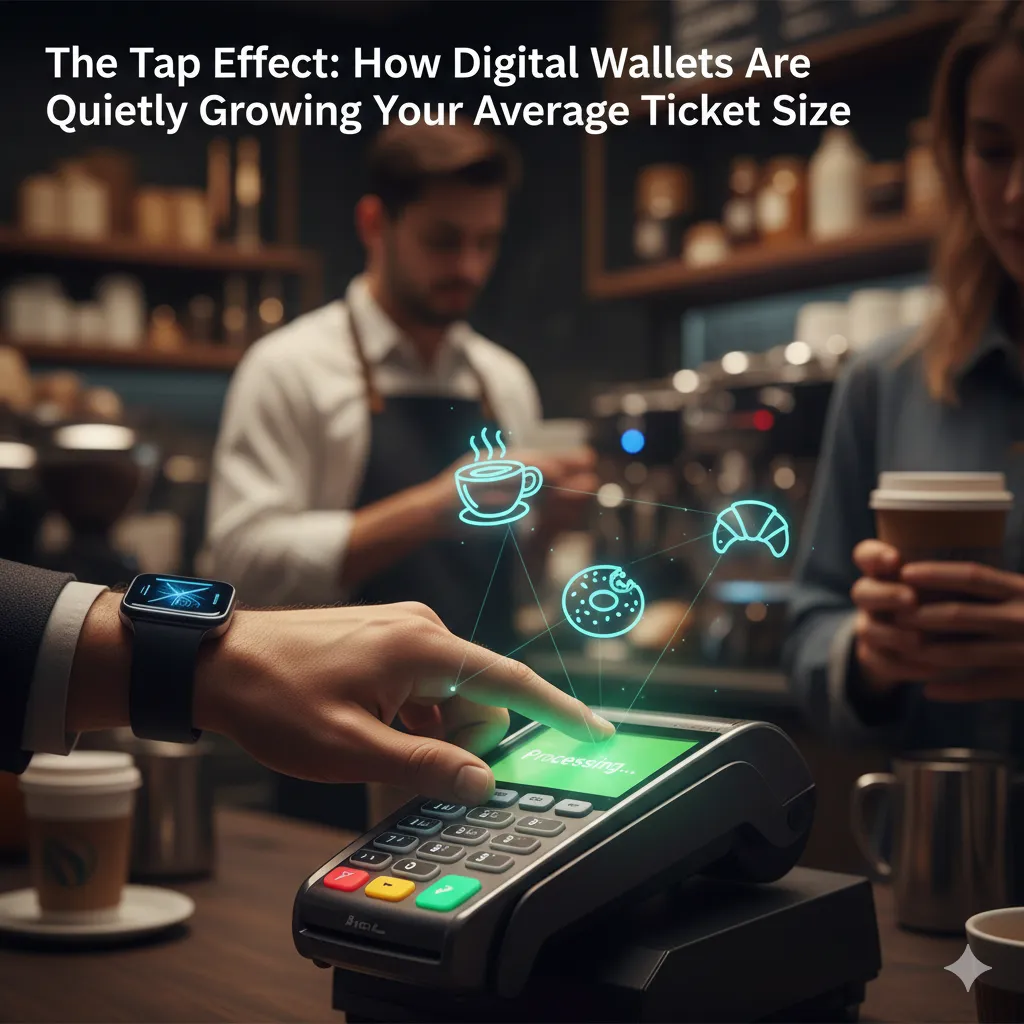
It’s a question I hear from business owners across the Five Boroughs. There is a lingering fear that Apple Pay for Business or Google Pay is just another way for tech giants to take a slice of the pie. But here is the reality I’ve seen on the ground in 2026: The "fee" is a drop in the bucket compared to the "Lift." When you embrace the Digital Wallet NYC lifestyle, you aren't just speeding up your line; you are tapping into a psychological phenomenon that significantly increases your average transaction value.
The Death of "Payment Pain"
In behavioural economics, we talk about the "Pain of Paying." When you hand over a crisp $20 bill, your brain registers a physical loss. You see your wallet getting thinner. That tactile experience acts as a natural speed bump for spending. Even swiping a physical credit card has a level of "cognitive friction"—you have to find the card, insert it, and wait.
Digital wallets have effectively killed that pain.
By 2026, the checkout process will have become nearly invisible. A quick biometric scan of a face or a thumb, a satisfying ping from the terminal, and the transaction is over. Because there is zero friction, the "logical" brain—the part that asks, "Do I really need this extra pastry?" doesn't have time to catch up with the "impulse" brain. This is one of the primary tap-to-pay benefits: it removes the hesitation that kills add-on sales.
The "Funny Money" Effect in 2026
Research has shown that people are often willing to pay a premium—sometimes up to 100% more—when the payment method is abstracted from physical cash. With a digital wallet, money feels less like a resource and more like a "background utility."
In NYC, where the pace is relentless, customers prioritize convenience above all else. If your shop makes it easy to tap and go, you become the "path of least resistance." I’ve seen retail data this year showing that contactless-enabled accounts spend significantly more per visit than those using traditional "dip" or "swipe" methods. Why? Because the transaction feels like a breeze, not a chore.
Speed as a Revenue Generator
Beyond the psychology of the individual, there is the math of the crowd. We know that in 2026, a 10-second delay at the register can lead to a 15% increase in line abandonment.
When you use Apple Pay for Business or modern NFC terminals, you are processing transactions up to 10 times faster than traditional methods. Faster lines don't just mean "happy customers"—they mean you can fit 20% more transactions into a peak lunch hour. For a high-volume NYC business, that increased throughput far outweighs the standard processing fees you’d pay on any other card transaction.
FAQs
Do businesses get charged more for Apple Pay than regular credit cards?
No, Apple does not charge merchants any additional fees to accept Apple Pay. You simply pay your standard credit card processing rates as determined by your merchant service provider. In fact, because contactless payments are more secure and use tokenization, they can sometimes even help lower your fraud-related costs.
Why do customers spend more when using digital wallets?
Digital wallets reduce "payment friction" by removing the tactile and visual cues of spending money. The speed and ease of the transaction prevent the "cooling-off" period, where a customer might reconsider an impulse purchase, leading to higher average ticket sizes.
Is Apple Pay for business secure for small retailers in NYC?
Yes, it is significantly more secure than traditional cards. Apple Pay uses "tokenization," meaning your business never actually sees or stores the customer's real card number. Combined with biometric authentication (Face ID/Touch ID), a fraudster can't use a "stolen" digital wallet at your terminal.
What are the main tap-to-pay benefits for a retail store?
The primary benefits include faster checkout times, which reduce line abandonment; increased average transaction value through "frictionless" impulse buying; improved security and lower fraud risk; and meeting the expectations of Gen Z and Millennial shoppers who often don't carry physical wallets.
How do I set up a digital wallet NYC payment system for my shop?
If you already have a modern credit card terminal, it is likely already equipped for NFC (Near Field Communication). You simply need to ensure your merchant account is configured to accept contactless payments. At Circle Processing, we can help you activate this and train your staff to encourage "taps" to speed up your lines.
Unlock Your Store’s Hidden Potential
The goal isn't just to take payments; it's to facilitate a shopping experience that makes your customers feel good about spending their money with you.
Would you like me to analyze your last three months of transactions to show you the "Ticket Gap" between your cash customers and your digital wallet users, so you can see exactly how much revenue you’re leaving on the table?
