Best Payment Solutions for Catering & Hospitality| Circle Processing
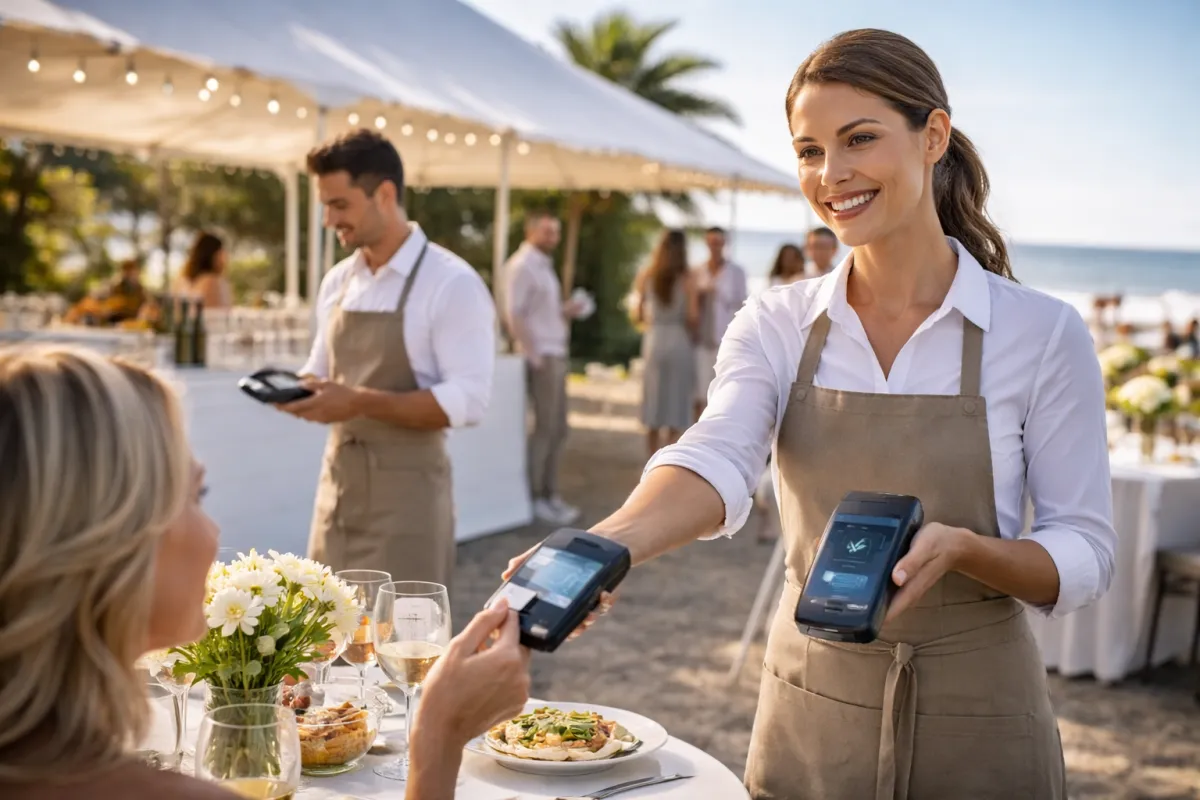
If I run a catering company, event team, beachside hospitality business, or seasonal venue in New York, summer is not the time I want my payment setup to feel fragile.
This is when volume spikes, environments get unpredictable, and checkout has to happen wherever the customer is, not wherever the counter happens to be. For businesses serving high-volume outdoor events in places like the Hamptons or along the Jersey Shore, the real payment question is not just “Can I take cards?” It is “Can I keep taking payments fast and reliably when Wi-Fi is weak, lines are long, and my staff are moving constantly?” Circle Processing positions itself around modern POS systems, terminals, and mobile-friendly payment setups, and its site specifically says the Clover Flex is a powerful handheld device for restaurants and mobile payments.
That is exactly why I see the best summer payment solution as more than a terminal. It needs to be mobile, contactless-ready, and built for busy field conditions.
Why Summer Is Different for Catering and Hospitality?
Summer service is harder on payment operations than many businesses expect.
At outdoor events, private parties, seasonal pop-ups, beach clubs, weddings, and off-site catering jobs, the payment environment is usually less controlled than it is inside a fixed-location business. Staff are moving across spaces, guests expect faster service, and stable wired infrastructure is often not part of the setup. Circle Processing’s own content emphasizes that faster NFC and digital-wallet payments can improve throughput during peak periods, which matters even more in event-driven hospitality environments.
If I am handling a crowded summer event, slow checkout does more than annoy customers. It slows bar lines, delays table turns, backs up concession flow, and reduces how many transactions I can complete while demand is highest.
The Biggest Mistake Seasonal Operators Make
The most common mistake I see is relying on a payment setup that works well enough indoors and assuming it will hold up outdoors.
That is risky.
A fixed countertop mindset does not translate well to:
outdoor weddings
poolside service
rooftop events
beach-adjacent hospitality
tented catering
mobile bars
seasonal pop-ups
banquet overflow spaces
For those situations, I want mobile merchant services that support service where the customer actually is. Circle Processing’s product guidance repeatedly points merchants toward Clover Flex for restaurants and mobile payments, which is a strong clue that the company sees mobility as a core fit for hospitality use cases.
What the Best Summer Payment Setup Needs
If I am choosing the best payment solution for the 2026 summer season, I want a setup built around four things:
1. Mobility
My team should be able to take payments tableside, poolside, curbside, or anywhere else service is happening. A handheld device matters because it removes the need to send guests back to a fixed register.
2. LTE or Cellular Backup
Outdoor events are where weak venue Wi-Fi can become a real problem. Official Clover documentation says Clover Flex supports Wi-Fi and LTE, and Clover’s developer specs also list 4G LTE among supported connectivity options.
3. Contactless Acceptance
Guests increasingly expect tap-to-pay and wallet payments. Clover Flex accepts chip, swipe, and contactless payments including Apple Pay, Google Pay, and Samsung Pay, according to Clover’s official product page.
4. Speed During Rushes
During summer events, speed matters as much as acceptance. Circle Processing’s own blog argues that contactless and wallet-enabled checkout can increase transaction throughput during peak windows.
Why LTE Matters More Than Hospitality Operators Think?
For many seasonal businesses, the real issue is not whether a payment device is portable. It is whether it stays connected when the environment gets messy.
That is why I care so much about LTE-enabled hardware for outdoor use. Clover’s official product page says the Clover Flex has Wi-Fi and LTE connectivity, which makes it better suited to field conditions than a device that depends only on local Wi-Fi.
For summer catering and hospitality, that matters because outdoor venues often deal with:
overloaded guest Wi-Fi
dead zones on large properties
temporary event networks
inconsistent router coverage
movement between service areas
When the payment device can rely on LTE in addition to Wi-Fi, the setup becomes more resilient.
Why Handheld POS Works So Well for Catering?
A handheld device is one of the smartest upgrades a catering or hospitality business can make because it turns payment into part of the service flow instead of a separate step.
With a mobile terminal, staff can:
close tabs faster
take payment at the table
process guest purchases during line movement
reduce crowding at a central station
shorten the time between order and payment
Clover’s official site describes Clover Flex as a handheld POS system with built-in payment acceptance, Wi-Fi and LTE connectivity, and support for contactless wallets. Circle Processing’s own site specifically describes it as ideal for restaurants and mobile payments.
That combination makes a lot of sense for Outdoor POS NY's needs, especially in seasonal hospitality, where the service footprint can change from event to event.
Why Contactless Matters More in Summer?
Summer hospitality tends to be faster, more social, and more movement-heavy.
That means customers are even less interested in slow payment rituals. They want to tap and move on. Circle Processing’s digital-wallet article explicitly links contactless checkout with faster transactions and greater throughput during busy service periods.
For catering and event service, that can translate into:
shorter bar lines
faster guest turnover at concession points
smoother closing at private events
easier payment acceptance for roaming staff
less friction on impulse purchases
In a high-volume summer setting, those gains matter.
The Best Fit for Different Summer Hospitality Models
Not every hospitality operator needs the exact same setup, but I would break it down like this:
For caterers and private-event teams
I want a handheld terminal with LTE, contactless acceptance, and battery life strong enough for full-service event work. Clover’s official page says Clover Flex offers at least 8 hours of battery life for a typical SMB, plus Wi-Fi and LTE connectivity.
For outdoor bars and food service
I want fast contactless checkout and mobility so staff are not tied to a single register. Circle Processing’s positioning around contactless speed and Clover Flex’s wallet acceptance support that use case well.
For seasonal pop-ups and temporary hospitality setups
I want a mobile-first solution that can go live without heavy installation. Circle Processing’s product mix of POS systems and terminals, plus its emphasis on handheld hardware, fits that need.
What I Would Prioritize Before Summer Starts?
If I were helping a hospitality operator get ready for the 2026 season, I would focus on these questions:
Can my staff take payments anywhere?
If not, I am already behind. Summer service often happens away from a fixed counter.
Do I have LTE-capable hardware?
If my whole setup depends on venue Wi-Fi, I have more risk than I should. Clover’s official specs make LTE a major advantage for handheld field use.
Can I accept digital wallets?
Wallet acceptance is now standard customer behavior, especially for fast-moving hospitality environments. Clover Flex officially supports Apple Pay and Google Pay.
Is the device actually suited to restaurants and mobile service?
Circle Processing’s own guidance says yes for Clover Flex.
Why Circle Processing Fits Seasonal Hospitality So Well?
Based on its current website and content, Circle Processing is clearly leaning into the kind of payment setup seasonal operators need.
Its site highlights:
POS systems and terminals for modern business setups
Clover Flex as ideal for restaurants and mobile payments
contactless-payment speed and wallet acceptance benefits
merchant support built around practical business use, not just hardware sales
For catering companies, outdoor venues, and hospitality businesses heading into summer, that is a relevant combination because the goal is not just to own a terminal. It is to have a payment system that keeps working when the service gets busy and mobile.
My Bottom Line for Summer 2026
If I am operating in hospitality this summer, especially in outdoor and event-heavy markets, I do not want to be stuck with a payment setup built for a quiet indoor counter.
I want:
a handheld device
LTE connectivity
contactless wallet acceptance
restaurant-friendly mobility
fast checkout during rushes
That is why I see the best payment solutions for the 2026 summer season as mobile-first and event-ready. Circle Processing’s positioning around Clover Flex, contactless speed, and mobile-friendly service lines up very well with that reality.
