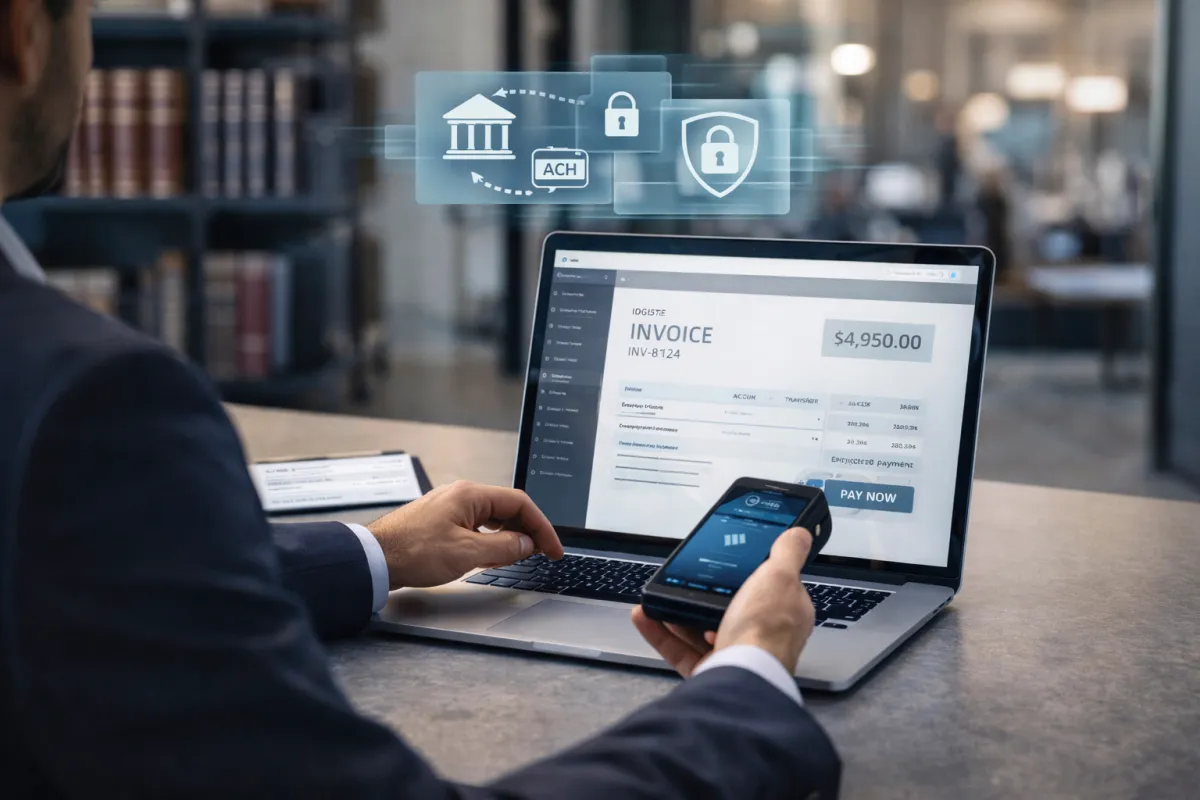
B2B Payments: Ditch Checks for Secure Digital Invoicing | Circle Processing
If I run a law firm, CPA office, consulting practice, or another professional-services business, checks can feel familiar. They also create a mess.
A client says the check is in the mail. It shows up late. It gets deposited days after the invoice was due. Then there is the real headache: returned payments, bounced checks, mail delays, and the awkward follow-up that wastes staff time and slows cash flow. Meanwhile, the rest of the business world keeps moving toward faster electronic payments. Nacha says the ACH Network processed 8.1 billion B2B payments in 2025, up 9.9% from 2024, which is a strong sign that businesses are steadily moving away from paper for supplier and invoice payments.
That shift matters because checks are not just slow. They are risky. The 2025 AFP Payments Fraud and Control Survey found that checks were the payment method most often subjected to fraud, with 63% of organizations reporting attempted or actual check fraud in 2024. AFP also notes that checks remain heavily used despite that risk.
So when I talk about modernizing B2B payments, I am not talking about adopting technology for its own sake. I am talking about reducing friction, protecting cash flow, and getting paid in a way that feels more secure and more professional.
For this article, I’m focusing on the Circle Processing service mix you specified: B2B Payment Gateway, Digital Invoicing NY, and ACH processing, alongside what Circle Processing currently highlights on its site, including secure payments, virtual terminal capabilities, encrypted card storage, and merchant tools designed to make payment acceptance more flexible. Circle also positions itself as a profitability-focused processor with Clover tools, virtual terminal support, secure card storage, and 24/7 U.S.-based support.
Why Checks Still Cause So Many Problems for Professional Services?
If I am a lawyer or CPA, the check problem usually looks deceptively small at first.
It starts with one client mailing payment late. Then another says accounting only cuts checks on Thursdays. Another check gets lost. Another clears slowly. Then one bounces, and suddenly I am spending time on collections drama instead of client work.
Checks create friction at nearly every step:
slower invoice settlement
delayed cash flow
manual deposit handling
more back-office follow-up
higher fraud exposure
more awkward client conversations when something goes wrong
That last point matters more than people admit. In professional services, payment friction affects client experience too. A digital invoice with ACH or card payment options usually feels cleaner and easier than asking a client to print, sign, mail, and hope.
Why More B2B Firms Are Moving Away from Checks?
The trend away from checks is not theoretical anymore.
Nacha’s 2025 ACH figures show continued growth in business-to-business ACH volume, and Nacha’s January 2026 release explicitly said that businesses large and small are “turning their backs on checks,” with that trend continuing into 2026.
That makes sense from an operations standpoint. If I want to reduce payment delays, simplify reconciliation, and stop depending on paper mail, digital invoicing and ACH are the obvious next steps.
The Federal Reserve’s payments coverage of AFP’s 2025 survey also reinforced the same problem: checks remain heavily used, yet they continue to be the payment type most exposed to fraud.
The Real Cost of “Sticking With Checks”
A lot of firms look at checks and think, “They do not cost me much.”
I disagree.
The cost of check dependence is usually hidden in:
staff time
payment delays
uncertain cash timing
manual deposit trips
error handling
returned-payment follow-up
fraud risk
slower month-end close and reconciliation
If I have to chase down just a few late or failed check payments each month, the true cost is already higher than most firms realize.
What Secure Digital Invoicing Actually Solves?
When I move from checks to digital invoicing, I am solving multiple problems at once.
A good digital invoicing setup helps me:
send invoices faster
give clients easier payment options
get paid without waiting on the mail
reduce manual handling
create cleaner records
shorten the time between invoice and deposit
That is why Digital Invoicing NY is not just a convenience phrase. For service businesses, it can be a practical way to improve both collections and professionalism.
Circle Processing’s site does not pitch itself only as a basic card processor. It also highlights virtual terminal functionality, secure card storage, encryption, and merchant support, which are exactly the kinds of tools that support digital invoice workflows and remote payment acceptance. Circle says its virtual terminal lets merchants accept payments from a computer, tablet, or smartphone and handle invoices or incoming payments even when the customer and card are not physically present.
Why ACH Makes So Much Sense for B2B Invoices?
If I am taking larger payments from professional-service clients, ACH is often one of the best options to offer.
It is familiar to business finance teams, widely used, and increasingly central to B2B payments. Nacha says U.S. businesses relied heavily on the ACH Network in 2025, with trillions in value moving through it.
From a workflow standpoint, ACH often makes sense because it:
fits invoice-based payments well
avoids mailing delays
can reduce dependence on paper checks
gives clients a bank-to-bank payment option
supports recurring or repeat billing relationships
For law firms, CPAs, and similar service providers, that can be a major upgrade over the “invoice now, hope the check arrives later” model.
Is ACH Perfect? No. Is It Usually Better Than Checks? Yes.
I do not like presenting ACH as magic.
ACH still needs controls. Fraud risk does exist in electronic payments too. The 2025 AFP survey found that ACH-related fraud also remains a concern, especially through business email compromise and debit fraud scenarios.
But that does not make checks the safer choice. AFP and related banking commentary continue to emphasize that checks remain the most-targeted payment type for fraud. AFP also states that ACH, wire, and real-time payments generally offer stronger encryption and better fraud controls than paper checks.
So the smarter takeaway is this:
move away from checks, but implement digital payments thoughtfully.
The Psychology of Why Clients Pay Faster Digitally
There is also a behavioral advantage here.
If I send an invoice with a clear digital payment option, the client has fewer excuses to delay. They do not have to:
print anything
locate a checkbook
get a signature
mail an envelope
remember to bring a check to the office
The easier I make it to pay, the more likely the client is to pay on time.
That does not mean every invoice gets paid instantly. It means I remove a lot of the friction that encourages procrastination.
Why B2B Payment Gateways Matter?
This is where firms often need to level up their thinking.
A B2B Payment Gateway is not just about accepting cards online. In practice, it is about creating a structured payment environment where invoices, remote payments, ACH, and secure client payment data all work more smoothly together.
Circle Processing’s current site highlights a few pieces of that stack:
MOTO and virtual terminal services
secure and compliant card information storage
fully encrypted transaction handling
24/7 U.S.-based support
tools that let merchants accept payments on computers or connected devices
For a B2B firm, that matters because invoice payments often happen remotely, not at a countertop.
Why Lawyers and CPAs Are Especially Good Candidates for Digital Invoicing?
Professional services are a natural fit for digital invoice payments because the client relationship is already administrative and document-driven.
If I am invoicing for:
legal retainers
advisory work
tax preparation
bookkeeping
audit support
consulting
recurring monthly service packages
then a digital payment model usually makes more sense than waiting on paper. It keeps the billing process aligned with how the rest of the client relationship already works.
That is especially true when the firm wants fewer payment surprises and more predictable cash collection.
What Does a Better Payment Workflow Look Like?
If I were replacing checks with a cleaner B2B setup, I would want this process:
Invoice goes out digitally.
Client sees clear payment options.
ACH is available for bank-to-bank payment.
Card payment is available where appropriate.
Payment can be accepted remotely and securely.
The firm has cleaner records and easier reconciliation.
That is why the phrase Digital Invoicing NY should not be treated as generic marketing language. For firms in New York and beyond, it can be a direct operational upgrade.
What Circle Processing Brings to This Conversation?
Based on its current site, Circle Processing’s strongest publicly visible positioning is around:
virtual terminal and MOTO payment acceptance
secure card storage
encrypted transactions
support for mobile and computer-based payment intake
Clover-based payment systems
24/7 U.S.-based support
profitability-focused merchant solutions
For the service mix you specified here, that makes sense in a B2B invoicing context. A firm moving away from checks needs the ability to send invoices, accept remote payments, support ACH processing, and manage client payment handling securely.
So even though Circle’s homepage does not spell out every B2B invoice workflow in detail, its existing payment stack clearly supports the direction you want the article to emphasize: less paper, more secure digital payment acceptance, and fewer payment delays.
What I Would Tell Any Firm Still Dealing With Check Drama?
If I were speaking directly to a law office or CPA firm still relying on checks, I would say this:
You are not just tolerating an old payment habit.
You are tolerating slower cash flow, more manual work, and more fraud exposure than you probably need to.
Checks are familiar, but familiarity is not efficiency.
A better approach is to:
digitize invoicing
offer ACH
make remote payment easier
reduce mail dependence
create a cleaner collections process
And if a bounced check has ever triggered awkward client follow-up, you already know how valuable that change could be.
Final Thoughts
If I want to ditch expensive checks for something more secure and more professional, digital invoicing is the obvious next move.
Checks are slower, more manual, and more exposed to fraud than many firms realize. ACH use in B2B keeps growing, while fraud data continues to show that checks remain the most frequently targeted payment type.
For lawyers, CPAs, and other professional-service firms, that means the old way of handling invoice payments is becoming harder to justify.
And for this article’s stated Circle Processing service focus on B2B Payment Gateway, Digital Invoicing NY, and ACH processing, the fit is clear. Circle’s site already emphasizes the virtual terminal, secure payment storage, encryption, and remote payment capabilities that support exactly that kind of modernization.
